Writing Elsewhere Geographies
a collective (un)learning and generative writing space serving as a container for grief praxis | generative refusals | prefiguring for liberation | co-creating-curating liberatory present-futures
Course Overview
We are living in a moment of profound dissonance. The dissonance and ruptures are further amplified due to our social webs, digital algorithms, and spatiotemporal disconnects (and discontents) of how we move through the geographies of this world: from the individual to the relational to the communities we are embedded within. Through forces of capital and technocracies, we are also seeing an alarmingly fast erosion of our learning and unlearning spaces, of spaces where we can carefully and intentionally labor to build understanding and other sovereign ways of being. The course offers a portal and a third space, beyond the narrowness of learning within institutions, beyond the dogma of academy.
Writing Elsewhere Geographies intends to be a space where we gather to learn, curate, and imagine other methods and modes of being and belonging in the here and now. The heart and spirit of the course are invitations to sit with the grief of the losses of our institutions of care, the ruptures of our relational ecologies—with each other and our more-than-human worlds—and distortions of our shared cultures; and to practice recognition and refusals of the systems of domination and extraction that live within us, between us, and of which we have become (un)willing participants. A reminder that holding space for collective griefs and practicing generative refusals in honesty and vulnerability is our first responsibility to the possibilities of our futures.
Edward Said wrote: “In the history of colonial invasion maps are always first drawn by the victors, since maps are instruments of conquest. Geography is therefore the art of war but can also be the art of resistance if there is a counter-map and a counter-strategy.” Writing Elsewhere geographies invites us to create-curate these counter-maps. The cartographies and architectures and maps we imagine, experiment with, and cultivate towards worlding the worlds we inhabit. Colonial conquest manifests beyond the geographies of place and borders, permeating into the geographies of our cultural symbols, shared languages, our collective institutions and ways of being. Our stories about ourselves and our past-present-future world are over-determined and over-represented by the systems of empire, colonization, and domination. Other ways of living and being have always existed. Through conversation and writing we will remember this, to liberate our imagination and our possibilities from the colonizers' fantasies, to write in community towards the ways our lifeworlds can be.
Course Ethos
TEXTURE AS PEDAGOGY.
The pedagogical anchors for the course are meant to be embodied and generative—sitting with grief, practicing refusals, becoming comfortable with discomfort, embracing the messy process of un|learning and collaborative sense-making as knowledge. As the course host and facilitator, my intention here is to create a space to encourage, guide, and nurture these vulnerabilities as necessary pieces of radical transformations of our selves and relations towards liberatory possibilities.
SYLLABUS AS INVITATIONS.
The course material draws from across neuroscience and psychology, (decolonial, anti-colonial, anti-imperial, anti-patriarchal) liberatory writing, and literary art. The goal isn't to offer these as abstract theoretical ideas on elsewhere geography worldbuilding, but rather a witnessing of the ways our past-present ancestors and more-than-human kin have made living through the ruptures and cracks. Our collaborative elsewhere-making will foreground our lived experiences, ancestral belonging, bodily autonomy and cultural positionalities and privileges. We will collectively build our understanding of the empires within and between us, the organizing principles of the systems that dominate us and extract from our planet, how we are also part of the systems we fight, and what else might be possible.
WRITING AS METHOD, PROCESS, AND RESISTANCE.
The course isn't meant to be or modeled as a writing workshop. My intention is offer writing as one method of liberatory praxis—one that moves beyond its individuated, commodified, algorithmic forms. Different forms and genres of writing will be introduced as experimental sandboxes for elsewhere-making, such as erasure or blackout poetry, persona poems, revolutionary poetics, lyric essays, and speculative fiction. Writing will be practiced through letter-writing in pairs, collaborative and communal writing, weekly generative and long-form writing prompts, deep listening and counterlistening exercises, mapping and countermapping experiments.
Guiding Questions
What are the mirrors and mirages of this here-geography?
How can we grieve the here-geographies in ways that are generative and rebellious?
Why does engaging in imagination feel elusive and risky?
What inquires, reckonings, and fugitive practices are necessary to build the cartographies of our becoming and belonging?
What are the conditions of liberation?
How do bring about the birth, regeneration, and renewals of the conditions of liberation?
How do we construct survival from within geographies of violence and oppression?
How do we reclaim our agency and attention as prefiguring for liberation?
How do we commit to the necessary task of refusals? How do we refuse in community?
How can we engage in liberatory modes of being through connection and collaboration?
Why Me and Why Now
As a scientist, I was trained in the language of neutrality, that science is apolitical and always pro-humanity, with no regard to the realities of medical apartheid or that much of sci-tech forms the material sustenance of warfare i.e. imperial genocides and colonial conquests. As a writer, I am contending with similar questions on how cultural production isn't neutral either: which stories are told, amplified, lauded with applause and awards, which voices are silenced, left out of the archives, which stories are manipulated through imperial stenographers (i.e. media, academia, law). What does it mean to do science, tech, or engage in any form of knowledge production amidst long arcs of colonialism and empire? At a time when we find ourselves witnessing multiple genocides (livestreamed, silenced) in our here and now. I bring these questions, refusals, lived experiences and trans|un-disciplinary knowledge to this course—not as expertise—but as context and tools for un|learning and diagnosing bullshit, being skeptical, following citations to investigate the archives, detect logical fallacies and to notice silences—who isn't named, who isn't implicated, which equivalences are normalized. I do not come to the pen from legacy but from the vantage point of an outsider — across gender, race, class, neurodivergence — a postcolonial child questioning empires, old and ones becoming.
Who Is This Course For?
• Writers and educators seeking a space to ground their learning and writing in a liberatory praxis
• Journalists, activists and community-engaged organizers seeking different frameworks for imagination and writing to strengthen practices of cultural and political resistance
• Anyone wanting to invest in collective un|learning and writing as a mode of liberatory praxis, and methods on how to carry this practice into their daily lives and livings.
• Folx within institutions (higher ed, nonprofits, academia, corporate) that want to push against currents of reformism and co-optation and capture of elitist extractive capital
What You'll Learn
- (I hope) You will leave this space gaining confidence and comfort in skepticism, asking the simple questions, challenging assumptions, engaging in refusal and saying "no" to the ways we are coerced into present-day systems of domination.
- Through the frameworks of geography and levels of analysis, you will be able to think more cohesively and thoroughly about the various systems and instances of oppression and domination. This will help avoid the traps of reductionist understanding that make the status quo feel inevitable, undefeatable.
- The framework of Elsewhere Geographies, maps, counter maps, diverse intelligences, will offer different ways to experiment with building and practicing other ways of breathing, living, co-existing, in our shared spacetimes.
- Engage in transdisciplinary study and writing rooted as an important aspect of liberatory praxis
- Some ideas and tools of literary craft and form to aid imaginative explorations
What's Included
Live Sessions
Interactive classes with your instructor
Session Recordings
Lifetime access to all recordings
Community Access
Connect with fellow learners
Certificate
Proof of course completion
Course Modules
WEEK 1. Here- and Elsewhere Geographies
1) What defines and determines the geographies of here: the stories we are told about ourselves and our world, the rules and symbols that crowd our imagination, the physical and conceptual maps that direct and constrict our daily movements. 2) The portal to the geographies of elsewhere: the stories we are not told and silences of the present-past cultural archives of kin who have made survival within collapse. 3) Practices and meditations for writing the geographies of elsewhere
WEEK 2. Psyche as a Site of Resistance | Diverse Intelligences as Elsewhere Geographies
1) "I" as the most private and immediate site of agency and action, as well as the site that is being acted upon subliminally and not-so-subliminally across the spaces and systems we occupy. 2) Embodying other ways of being, imagining affective states that are generative and kin-centric.
WEEK 3. Trust and Relational Ruptures | Kinships as Elsewhere Geographies
1) How does trust manifest in our relational spaces: what breeds mistrust, why is our world stuck in the holding pattern of ABOVE | BELOW hierarchies and domination. 2) How do we start communicating with each other in honesty and vulnerability?
WEEK 4. A World where Many Worlds Fit | Autonomous Zones as Elsewhere Geographies
1) How do we build spaces of collective care via mutual aid and reciprocal relationships? 2) Building worlds where many worlds fit: pluralistic worlds, worlds from below, worlds rooted in dignity and sovereignty. 3) Foregrounding social reproductive labour of individuals and institutions that sustains communities though often invisibilized, uncompensated, or co-opted by power.
WEEK 5. Countermapping an Elsewhere Geography
1) We will identify what roles and voices we feel most called to explore in living & writing elsewheres. 2) What comes up for us viscerally when sitting with grief and discomfort. 3) How do we invite others in co-creating-curating elsewheres and refusals of here-geographies.
WEEK 6. The Litany of Elsewhere Geographies | Project Sharing and Weaving Futures
We will share our findings, reflections, thoughts, projects, questions, fears, silences and ways to bring these back into our own lives, relations, communities, and institutions.
Real-World Project
Participants will be encouraged to work on a speculative reimagining of any mode of being from within their lives—a zine, op-ed or a narrative essay, or informal teaching guide or manifesto—towards reimagining either a personal trait, challenging an institutional framework, or questioning broader structures of oppression. Choose a medium (literary | investigative | educational) and scale (micro- | meso- | macro-) to create a counter-map, an elsewhere geography, to take back to your communities.
whether that's a personal radical transformation of a habit or thought
whether that's a rally call against a procedure or institution
whether that's learning to recontextualize and reimagine an entire structure
Your offering will begin and add to a repository of "Experiments in Elsewhere Geographies" curated from the present and future iterations of this course, hopefully towards creating a gift we can share freely with our larger worlds.
Session Schedule
About the Instructor

Neuroscientist | Writer | Activist
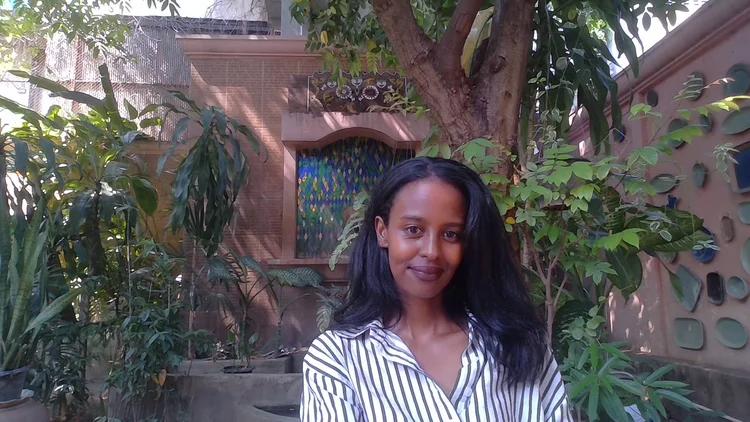
Shraddha is a neuroscientist and writer, concerned with questions of trauma, diverse intelligences, complicities of the academy, and tries to embody anti-imperial and anti-colonial liberatory modes of being. Faith, skepticism, rebellion, and curiosity fuel her writing, research, organizing, and all the quotidian existences in between. Her writing outside of scientific research has appeared in We The Soil, Revolute, Houston Chronicle, Mondoweiss, and Querencia Press. As an organizer, she co-founded ZinesforFalastin and Gaza Writers Series to amplify voices of indigenous Palestinian artists. These days, she's building Elsewhere Geographies, as a digital third space for collective study and un|learning. She also has editorial experience across Healthcare workers for Palestine, Science for the People, and ZinesforFalastin. She seems to like complicating her realities for the possibilities of simpler, freer, ethical living.
Frequently Asked Questions
$600
Stay informed about this course and future offerings.
Having issues or questions? Contact us
October 16
20 students max
6 sessions
120 min each
You Might Also Like
Relational Leadership as Design
Creative Responses to Climate Collapse: Worldmaking with Art & Literature
Collective Liberation & AI: A Decolonial Practice